Security Education
 OffSec
 iNE
iNE Antisyphon
 EC-Council
 Applied Network Defense
 Kaspersky
 Sektor7
 CompTIA
 TCM Security
 BlackHat
 13Cubed
 Dark Vortex
 Enciphers
 Forty North
 Cyber warfare Labs
 Maltrak
 Scorpio Software
 Security Onion
 Zero Point Security
 SentinelOne
 Altered Security
 SpecterOps
 Pentester Academy
 CQURE
CQURE PluralSight
 StationX
 Cybr
Cybr موسسههای دیگر
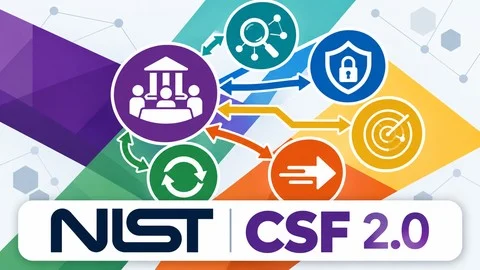
This course explains how the NIST CSF 2.0 works as an integrated, outcome-based framework—and how organizations can use it to understand risk, establish priorities, evaluate current capabilities, define desired outcomes, and build a practical cybersecurity improvement roadmap.
You’ll move beyond memorizing terminology and learn how the CSF Core, Organizational Profiles, Implementation Tiers, Implementation Examples, and Informative References work together. You’ll also see why the CSF describes cybersecurity outcomes rather than prescribing a universal list of controls.
Throughout the course, you’ll follow HarborPoint Client Services, a realistic case study that demonstrates how an organization can apply the NIST CSF 2.0 concepts to a business environment. You’ll examine organizational context, governance, assets, risk assessments, safeguards, monitoring, incident response, recovery, evidence, measurement, Profile gaps, and implementation planning.
Syllabus
- Intro
- Govern (GV) — The Steering Wheel
- Identify (ID) — The Digital Inventory
- Protect (PR) — The Defense Lines
- Detect (DE) — The Security Camera
- Respond (RS) — The Firefighters
- Recover (RC) — The Rebuilders
- Organizational Profiles: Turning the CSF into Priorities
- Tiers, Assessment, Measurement, and Implementation
- Using AI for CSF Analysis and Reporting