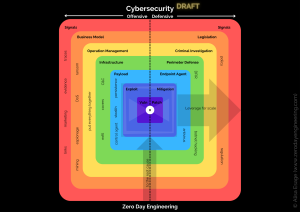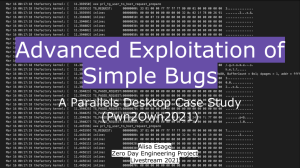
At Pwn2Own Vancouver 2021 I have demonstrated an 0day VM escape exploit for Parallels Desktop hypervisor. The exploit chain that I developed was based on logic issues. In this deep technical presentation I will share the technical details of the exploit, as well as various preliminary and contextual knowledge related to it.
Logic security vulnerabilities (i.e. those that can be exploited without any memory corruptions) are becoming increasingly important in offensive security research right now, as Rust and other memory-safe programming languages are rapidly taking over popular code bases. When evaluating the attack surface of Parallels Desktop, as an expert in both hypervisors and memory corruption bugs, I saw many opportunities for classical buffer overflows, but chose to try and find a logic bug instead. As hypervisors are ultra-complex low level software, exploitable logic bugs in them are extremely rare. I was lucky to find such a “one of a kind” bug.
Despite the bug was quite simple, the exploit turned out to be not so easy. Exploitation of the bug required me to develop a kernel module for the guest OS from which I was escaping, reverse-engineer some internal RPC protocol of the hypervisor, and emulate it in the exploit code. Eventually the exploit was reliable 100% by design, and executed arbitrary code on the host Mac. During the Pwn2Own competitions it came as a surprize that my exploit did not meet any collisions with other competition entries. Because the bug itself was quite easy, I expected that at least one participant would find and utilize it independently in their own Pwn2Own exploit. But it didn’t happen. That made me aware of the fact that a bug that looks easy does not necessarily imply an easy discovery or an easy exploitation process, an estimation which is very important for strategic aspects of offensive security research.
 Security Education
 OffSec
 iNE
iNE Antisyphon
 EC-Council
 Applied Network Defense
 Kaspersky
 Sektor7
 CompTIA
 TCM Security
 BlackHat
 13Cubed
 Dark Vortex
 Enciphers
 Forty North
 Cyber warfare Labs
 Maltrak
 Scorpio Software
 Security Onion
 Zero Point Security
 SentinelOne
 Altered Security
 SpecterOps
 Pentester Academy
 CQURE
CQURE PluralSight
 StationX
 Cybr
Cybr موسسههای دیگر